AGM, EFB, Flooded & CMF Batteries Explained: What’s the Difference?
Choosing the correct car battery has become increasingly complex. Gone are the days when a single "lead-acid" battery fit every car. Today, vehicles with Start-Stop technology, high electrical loads, and smart charging systems require specific battery chemistries. Installing the wrong type can lead to premature failure, system faults, or even damage to your car's electronics.
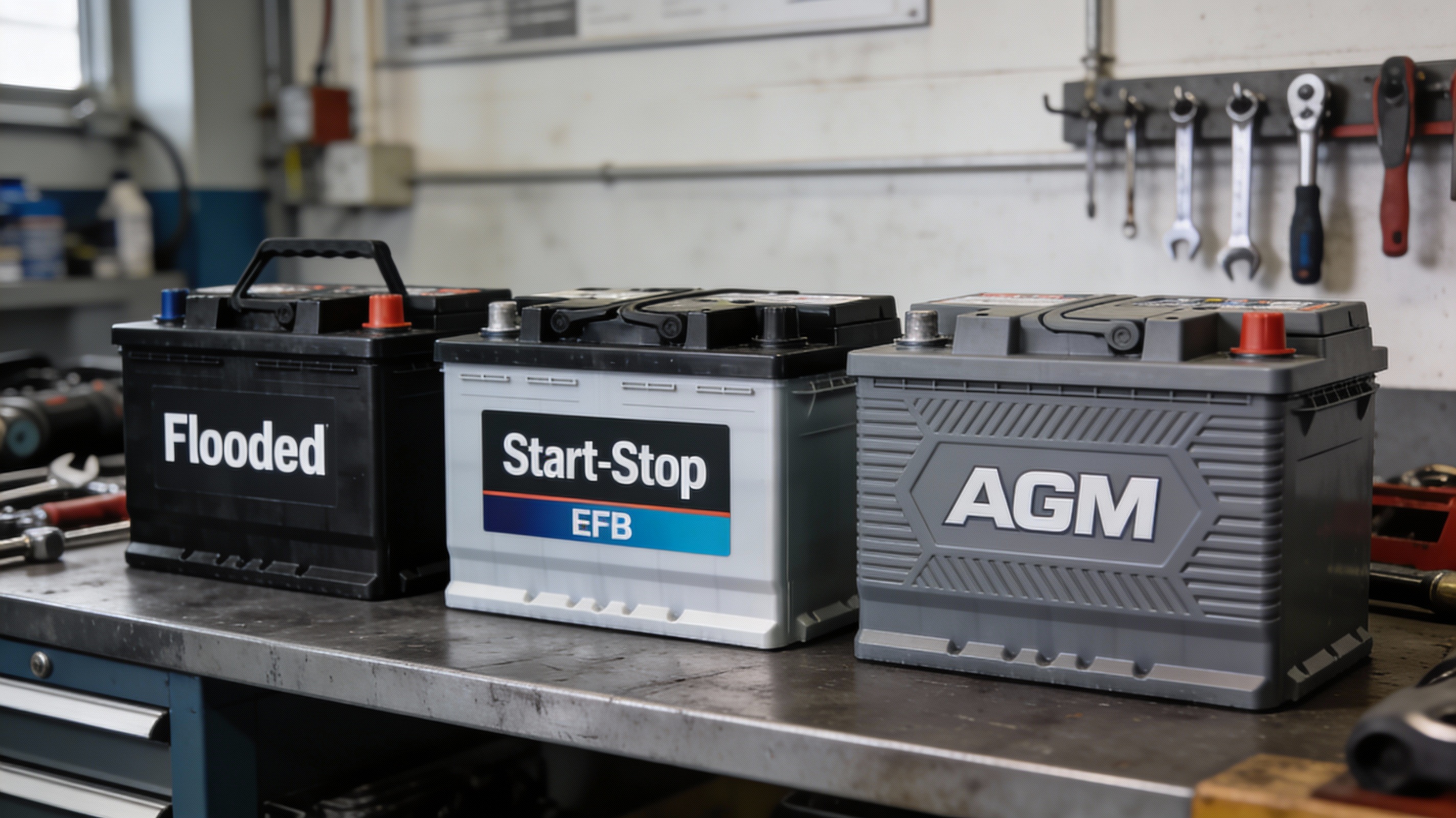
This guide breaks down the four main players in the automotive battery world: Flooded (SLI), CMF (Calcium Maintenance Free), EFB (Enhanced Flooded Battery), and AGM (Absorbent Glass Mat).
1. Technology & Construction
The fundamental difference lies in how the electrolyte (acid) is held and how the lead plates are constructed.
Flooded (SLI): The traditional "Starting, Lighting, Ignition" battery. It consists of lead plates submerged freely in a liquid sulfuric acid electrolyte. Older versions had removable caps to top up water lost during charging.
CMF (Calcium Maintenance Free): A modern evolution of the flooded battery. The lead grids are alloyed with Calcium instead of Antimony. This strengthens the plates and significantly reduces water loss, allowing the battery to be fully sealed (often with a "magic eye" hydrometer). It is technically a flooded battery but requires no maintenance.
EFB (Enhanced Flooded Battery): A bridge between standard and premium technologies. It adds a polyester scrim (fleece) to the positive plate surface. This scrim helps retain the active material on the plates, improving cyclic durability without the high cost of AGM.
AGM (Absorbent Glass Mat): The most advanced lead-acid technology. The electrolyte is not free-flowing; instead, it is absorbed into thin fiberglass mats sandwiched between the plates. The battery is compressed tightly, making it vibration-resistant and spill-proof.
2. Energy Output & Performance
How do they compare when you turn the key or run accessories?
Flooded: Designed for a short, high-current burst to start the engine, then immediate recharging. They struggle with deep discharges and sustaining high electrical loads when the engine is off.
CMF: improved Cold Cranking Amps (CCA) compared to older flooded batteries (often +15%). They hold charge longer when sitting idle due to lower self-discharge rates.
EFB: Offers roughly 2x the cyclic durability of standard flooded batteries. They accept charge more quickly, making them suitable for entry-level Start-Stop vehicles that need to restart the engine frequently.
AGM: The powerhouse. It delivers 3x the cyclic life of standard batteries and handles deep discharges far better. Its low internal resistance allows it to deliver massive bursts of power (CCA) and recharge significantly faster, essential for regenerative braking systems.
3. Charging Profiles
Charging requirements are critical—using the wrong setting on your charger can destroy a battery.
Flooded / CMF: Robust and forgiving. They typically charge at 14.4V - 14.8V. If you use a "Recondition" mode (high voltage to mix acid), it is generally safe for these types (if caps can be removed on flooded, be careful with sealed CMF).
EFB: Similar charging profile to standard flooded batteries but can accept higher charge currents.
AGM: Highly sensitive to overcharging. They require a specific AGM charging profile (usually capped at 14.6V - 14.7V). Exceeding this voltage causes the electrolyte to dry out, permanently damaging the battery since it cannot be topped up. Never use a high-voltage "Recondition" mode on an AGM battery unless your charger specifically says it is safe for AGM.
4. Lifespan & Durability
Flooded: 3-5 years in standard use. Lifespan drops dramatically if used in a Start-Stop car (often failing within months).
CMF: 3-5 years. The calcium alloy reduces corrosion, often extending shelf life and service life in hotter climates compared to older antimony batteries.
EFB: 4-6 years. Designed to handle the partial state of charge (PSOC) common in urban driving and Start-Stop traffic.
AGM: 5-7+ years. The tight internal compression makes them incredibly resistant to vibration (the #1 killer of batteries).